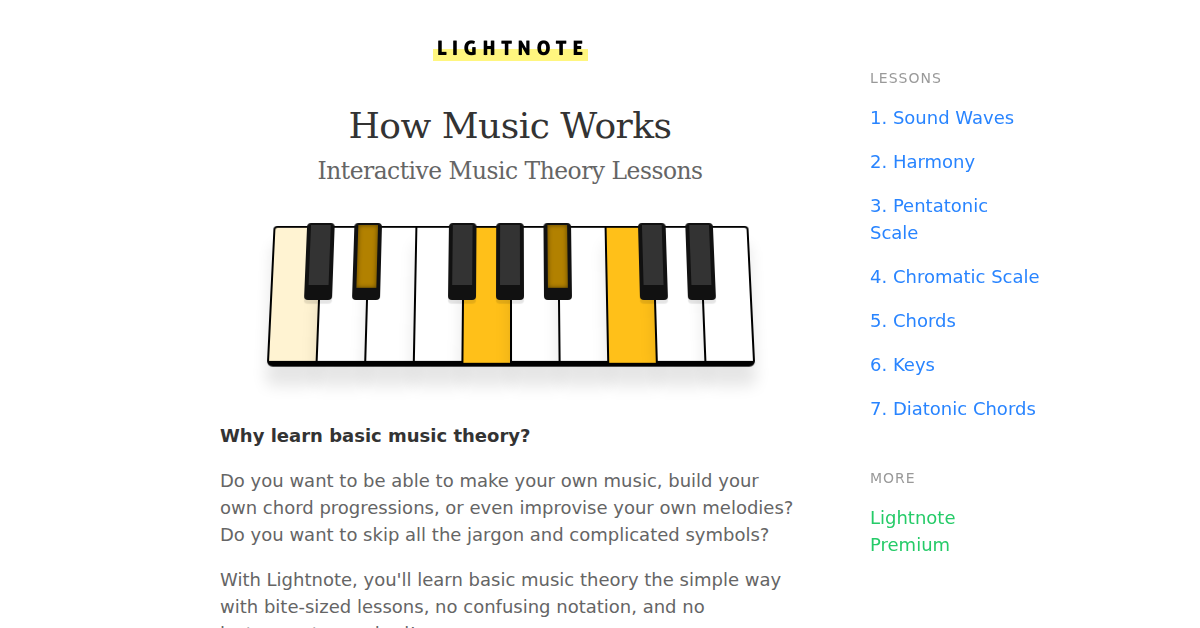
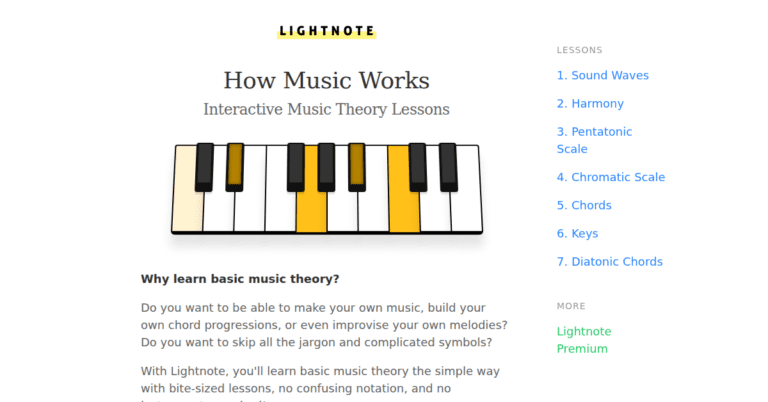
Music Theory that isn’t boring – Lightnote Premium Course How Music Works Interactive Music Theory Lessons Why learn basic music theory? Do you want to be able to make your own music, build your own chord progressions, or even improvise your own melodies? Do you want to skip all the jargon and complicated symbols? With Lightnote, you’ll learn basic music theory the simple way with bite-sized lessons, no confusing notation, and no instruments required! 1 Sound. What is it? A sound is a wave. Every sound is created from vibrations in the air. It can be louder… Increasing the height of the wave, or amplitude. …or more quiet. Decreasing the height of the wave, or amplitude. It can be lower in pitch… Lower notes will become longer waves. …or higher. And higher pitched notes will be more compressed. There are infinitely many notes. Not just the ones you know, like A through G, but everything in between. So how do we pick which notes to use? soft loud low pitch high pitch click me! 2 Harmony Notes that sound good together. What makes this sound good? Play …and this sound bad? Play A simple ratio between the notes means they sound nice together. Can you see the repeating pattern in the first one? Your ears can hear the simple ratio between these waves. It turns out that when the waves line up in nice patterns, it sounds good!!! Our ears like it when the ratio between the waves are simple. For example, three waves of note #1 for every two waves of note #2…
Find More Resources Like This
Browse related learning resources and providers on Learn Like This.

Find what fits your learner.
Search resources, start with a learning need, explore planners, or take a quiz to narrow down your options.
Looking for something specific?
Search our directory by subject, learning need, grade, resource type, or provider.

Find More Resources
Browse curriculum, classes, tutoring, learning tools, educational programs and support resources.
Browse Resources →
Start With the Need
Not sure what type of resource to look for? Start with the skill, challenge, or learning need instead.
Find Support →
Create Your Own Planner
Collect and organize resources in one place, build a plan around your learner’s needs, and share it if you choose. Or explore planners created by others.
Create or Explore Planners →
Take a Learning Quiz
Not sure which homeschool approach or curriculum style fits? Use our quizzes to narrow the options and discover a better match.
Find help by learning need
Sometimes it is easier to start with what your learner needs help with rather than knowing exactly what type of resource to search for.
Compare providers side by side.
Found a few options you like? Look for the Compare selector at the top of provider pages. Select the providers you want to compare, then review your options together to see which may be the best fit.
Find Providers to Compare →